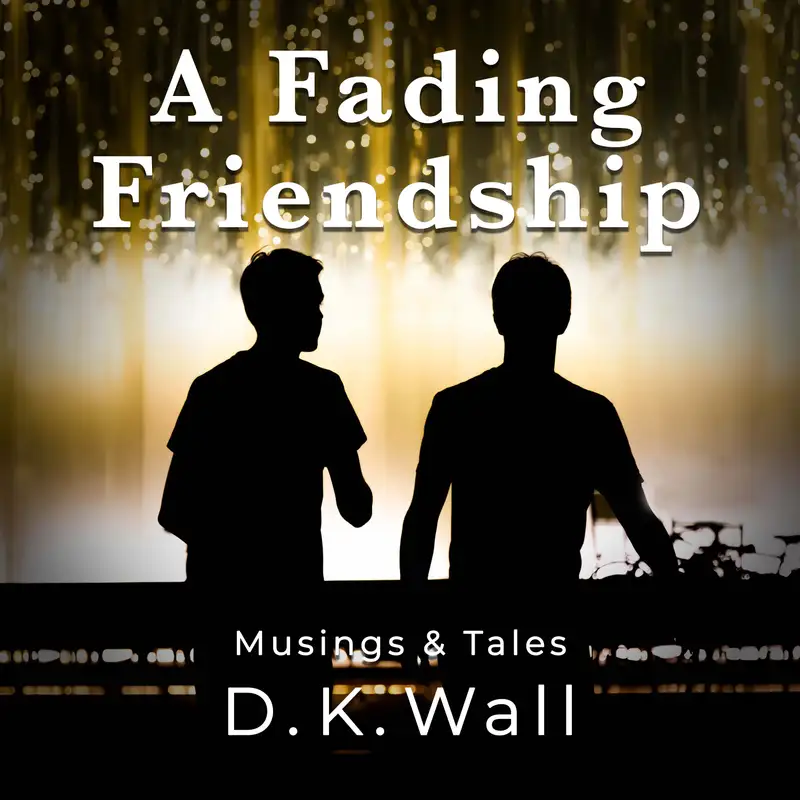
The tight friendship between Will Halloway and Jim Nightshade faded into nothingness. I don't know why.
D. K. Wall:Some of you will correctly note that those names belong to the 13 year old lead characters in Ray Bradbury's masterful tale Something Wicked This Way Comes.
D. K. Wall:Will, a fair child with white blonde hair, was born one minute before midnight on October 30. Jim, with his dark hair and eyes, was born two minutes later, in the first minute of Halloween.
D. K. Wall:Will is naturally cautious and follows rules, while Jim is brash and even reckless. Their friendship saved their lives.
D. K. Wall:But, this entry into Musings and Tales isn't about characters in a book. Instead, they are a pair of boys in my neighborhood. Alas, I don't know their real names, have barely spoken to them beyond a good morning or two.
D. K. Wall:But as I do with so many strangers I encounter in my life, I name them in my imagination. Though, frankly, I applied little effort because Bradbury's description of his characters meshed so well with these real life compadres.
D. K. Wall:I first noticed them last fall, shortly after the school year began. Walking the dogs toward the greenway early one morning, we passed Jim Nightshade first.
D. K. Wall:He set astride his bicycle, fidgeting with energy and glancing at his watch like a man about to miss his flight. His foot tapped. He released deep sighs and oozed frustration that he was going to be late for school.
D. K. Wall:Enter Will from a house three doors away. His appearance was disheveled. Wrinkled clothes, uncombed hair, and a bulging backpack with notebooks sticking out of the open flap. I guessed he had crawled out of bed only a minute or two earlier.
D. K. Wall:He grabbed his bicycle from its resting spot sprawled in the front yard and pedaled furiously to catch up as Jim shouted to him to hurry.
D. K. Wall:If that had been it, I would have never given them a second thought. My world and theirs were years apart and destined to remain that way.
D. K. Wall:Except, because our morning schedule and theirs crossed paths, we encountered them every few days. Jim nervously waiting, while Will was always tardy. Not once, not a single time do I recall the roles reversed with Will waiting on his buddy.
D. K. Wall:At some point, as the weather cooled, the leaves changed, and winter approached. They disappeared. Or, more accurately, we simply stopped crossing paths.
D. K. Wall:I forgot about them until last week. In the final dwindling days of the school year and with the summer vacation season approaching, we heard the hum of a bicycle approaching.
D. K. Wall:I glanced over my shoulder and saw a young, fair haired boy pedaling his bicycle hard. He passed us, leaned into the curve, and zoomed out of sight.
D. K. Wall:If I thought anything at all, and I don't really remember even that, I was probably amused that someone was eagerly approaching school so late in the year.
D. K. Wall:A few minutes later, as we neared the greenway entrance, another boy materialized. A darker haired lad pedaled unenthusiastically, weaving to and fro, obviously in no hurry to reach his destination before the first bell.
D. K. Wall:Then it hit me. Though he was no longer looking at his watch, no longer waiting to meet his buddy at the intersection, Jim Nightshade was riding past.
D. K. Wall:The other boy, the one who was so eager, was none other than Will Halloway, somehow transformed from the chaos some months earlier to a boy on a mission.
D. K. Wall:Things had clearly changed between them over the school year. They had switched roles. Will had evolved from haphazard to eager, while Jim had shifted from excited to lackluster.
D. K. Wall:Whatever changes had occurred, their friendship had clearly faltered as well. Despite taking the same path, they were no longer riding their bikes to school together. Kidding each other as boys do. No excited chatter. No banter.
D. K. Wall:What caused the fracture? Had one made a sports team and the other been cut? Did they both like the same girl and had she made her choice? Had the friends have a fight that created irreparable cracks?
D. K. Wall:I don't know. I never will. Not that such a detail ever stopped my mind from inventing endings.
D. K. Wall:Perhaps it's simple. A few days into summer, Jim is standing at the edge of the creek where the boys had always come, the spot worn bare by years of sneakers and dropped bicycles.
D. K. Wall:The air is thick with the green smell of mud and willow, and the heat presses down the way it only does in the first real week of vacation when the school year already feels like something that happened to someone else.
D. K. Wall:Jim has a pocket full of flat stones and nothing better to do with him. He sidearms one across the water four skips, then a fifth before it disappears.
D. K. Wall:Behind him, a bicycle ticks to a stop and clatters into the weeds. Jim doesn't turn around. He knows the sound of that bike the way he knows his own name.
D. K. Wall:Will stumbles down the path. Eyes red rimmed because the girl he had been seeing broke up with him in the last week of school, and he has run out of people who don't already know.
D. K. Wall:He says nothing. He just picks up a stone and throws it badly. It plunks and sinks. They stand in silence, each reaching for words they can't find.
D. K. Wall:Then they sit in the dirt. Knees up. And the conversation comes in spurts with long awkward pauses. The kind of silence that used to be comfortable and now has to be earned back a sentence at a time.
D. K. Wall:Will mumbles something about the girl. How she shattered his heart. Jim replies, that was her loss.
D. K. Wall:And then it warms. Jim tells a joke, an old one, a stupid one, the one that was never funny the first 100 times. Will laughs in spite of himself. And his mirth surprises them both.
D. K. Wall:Jim hands him a flat stone, a good one, the best in his pocket. Like this, he says and shows him the throw, the same one he's been showing him since they were seven.
D. K. Wall:Or, maybe, that's not what happens. Perhaps years pass. High school, college, careers.
D. K. Wall:And one day, sitting in the Kansas City Airport waiting on a delayed connection, Jim looks up from his Wall Street Journal, nervously checking for any sign the plane is ready.
D. K. Wall:The boy who once checked his watch like a man afraid of missing his flight is all these years later, a man in an airport, still watching the clock.
D. K. Wall:To his surprise, he spies a familiar face sitting a few rows away. He hesitates, unsure if his memory is playing tricks or if the conversation would simply be too awkward.
D. K. Wall:He tells himself to stand up, to cross the empty space between them, to ask how is he doing?
D. K. Wall:But then, the gate agent calls for boarding. Jim trudges onto the plane, stows his luggage, and settles into the aisle seat.
D. K. Wall:Studying the newspaper and chasing the fault of a missed opportunity out of his mind. Then a voice interrupts. Excuse me. I'm in the window seat. Jim looks up and Will stares back.
D. K. Wall:They talk as the plane taxis down the runway. Share photos of their kids on their phones. Trade stories of their careers and spouses and lives.
D. K. Wall:But, not all endings are golden. Perhaps Will is sitting in his den, reading the news, when a familiar face jumps off the page from the obituaries. Jim Nightshade killed in a traffic accident.
D. K. Wall:Will slips off his glasses and wipes away a tear, shed for a friend he hasn't seen in decades.
D. K. Wall:But me, I prefer the warmer endings, even if they take a long time to arrive.
D. K. Wall:A ringing phone on a summer evening. Jim Nightshade's wife answers and asks, Who's calling?
D. K. Wall:She turns to her husband and says, It's a Will Holloway. He says he wants to apologize for something that happened years ago. Jim nods and takes the phone.
D. K. Wall:That's the one I'd write. What about you? How would you write the next chapter?