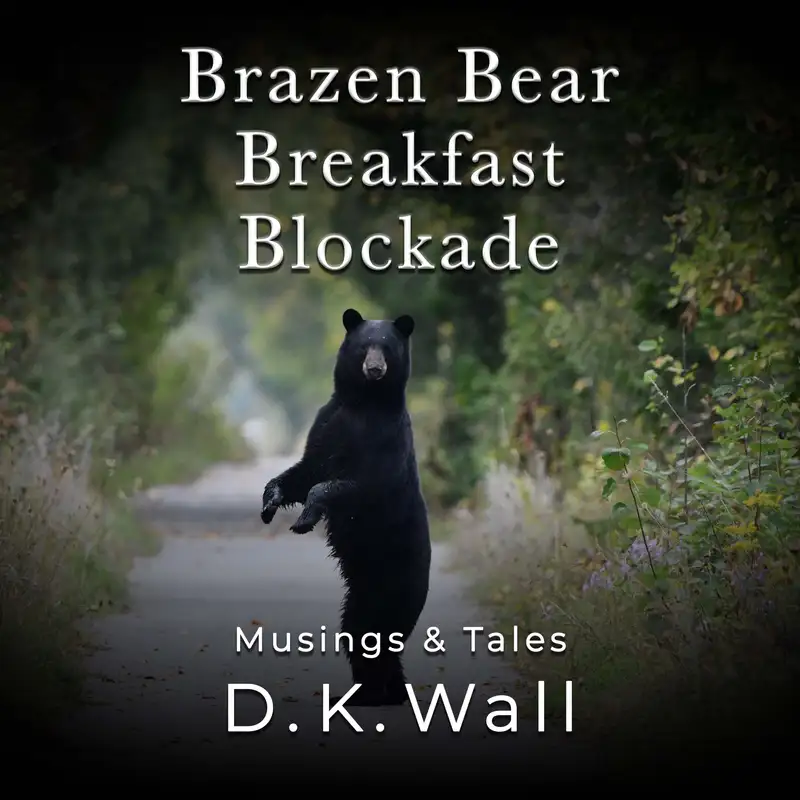
Walking the dogs on our neighborhood greenway last week, I made the rookie mistake of opening my mouth. You know, I said with the casual confidence of someone who has learned nothing, We haven't seen a single bear on the trail yet this year.
D. K. Wall:The next morning, fate collected. We hit the trail at sunrise, human feet and dog paws finding our rhythm on the winding path that threads through the wooded natural areas behind houses.
D. K. Wall:This is not exactly wilderness. We are still firmly within the Asheville city limits. Traffic was already building on the roads nearby, and once a fire truck announced itself in the distance with a blast of a siren. But mostly, we listened to the birds tuning up for their morning concert and the creek gurgling along beneath them, utterly unbothered by schedules or obligations.
D. K. Wall:And then something else, a low rumble, a grunt, maybe, or the suggestion of a growl, a sound that doesn't announce itself so much as imply a presence.
D. K. Wall:Three sets of husky ears swiveled like satellite dishes, three noses lifted, testing the air with the focused intensity of professionals, the rhythm of 12 paws slowed to a hush. Just off the side of the trail, in a thicket of brush, a shadow shifted within the shadows.
D. K. Wall:Landon reacted first. Regular readers will recall last week's tale. Landon, the eldest of our three Siberian huskies, snagging a rabbit and performing what can only be described as a victory lap through the backyard with the energy of an athlete who has been waiting his entire life for this moment. He is not a dog who underreacts.
D. K. Wall:He did not underreact now. You might picture a bear alert from a Siberian husky as something appropriately dramatic, a deep resonant bark perhaps, rolling across the forest floor and causing large animals to reconsider their life choices.
D. K. Wall:Or perhaps Landon would reach back through his ancestral memory, tap into ten thousand years of wolf DNA, and release a haunting, spine tingling howl. Even a low menacing growl would have been acceptable.
D. K. Wall:What Landon actually produced was none of those things. Landon's signature warning sound is best described as a Siberian shriek.
D. K. Wall:It's a high pitched, ear splitting squawk somewhere between a smoke alarm and a cockatoo with strong opinions. He deploys it when he is frightened, excited, hungry, bored, or simply feels that not enough attention is being paid to him. It is undignified. It is not intimidating.
D. K. Wall:It is, however, extremely loud. And it repeats with a cheerful relentlessness of that same smoke alarm mounted just out of reach on a nine foot ceiling at two in the morning.
D. K. Wall:The bear poked his head around the bush. He stared at us. Three Siberian huskies clumped together on the trail like a small furry committee, one of them making a noise that no living creature in the history of the North Carolina Mountains had ever made before, and a pair of humans doing their best to squelch the squawk.
D. K. Wall:The bear blinked. I addressed him politely, respectfully even. I suggested with great courtesy that if he could see his way clear to move off the trail, we would very much appreciate the passage and would not trouble him further.
D. K. Wall:Most bears will oblige this kind of request. They have, as a general rule, no more interest in dealing with humans or shrieking huskies than we have in them. It is a mutual agreement that has served both species well.
D. K. Wall:There was, however, the matter of breakfast. He had found a fallen tree and with the focused energy of a bear who knows what he wants, peeled back the bark to reveal what I can only describe as an ursine smorgasbord, a spectacular wriggling buffet of grubs. Delicious presumably if you are a bear, not so much if you are a human.
D. K. Wall:He planted his very substantial bear backside on the ground, turned his attention back to the log, and made his position clear. We, he indicated through posture alone, would simply have to wait.
D. K. Wall:And so we did. I have lived long enough to recognize the wisdom of strategic inaction. For those curious about the risk calculus here, I was not overly concerned.
D. K. Wall:A mother bear in April is a different matter entirely. Her cubs are young, she is vigilant, and she is not in the mood.
D. K. Wall:But this was a male bear, and male bears operate on a motivational system of magnificent simplicity. They want food. They won't sleep. That's the list. A lone male bear is far more interested in his grub buffet than in us. And as long as we weren't threatening him or his diet, we were simply furniture.
D. K. Wall:The life of a male bear, if examined honestly, is a masterpiece of low expectations. For most of the year, they pursue only that pair of passions, food and naps.
D. K. Wall:Occasionally, one might challenge another male bear over something important. But since other male bears are also interested only in sleeping and eating, these disputes resolve themselves in favor of whoever has the most convenient napping spot.
D. K. Wall:Come a month or two in late spring, male bears briefly add a third priority to their agenda, finding female bears and making baby bears. Since male bears are not, to put it gently, the settling down type, they pursue this goal with the subtlety of a singles bar at closing time.
D. K. Wall:This is also the season when male bears are most likely to fight each other because female bears turn out to be somewhat less abundant than food and comfortable sleeping locations, at least for this brief period of time. By late summer, it's back to the bachelor lifestyle, eating, sleeping, repeat.
D. K. Wall:The female bear, meanwhile, gives birth in the winter months, mothers the cubs for the better part of a year and a half, and then boots them out of the house. Just as she has eased them from the nest, another wandering male bear ambles through, fresh off his grueling schedule of napping and snacking, and insist she restart the biannual process.
D. K. Wall:I will let you draw your own parallels between the gender imbalance of bears and other creatures of this earth. Let's return to our situation.
D. K. Wall:There we stood, our little cluster, politely watching the frat boy of the animal kingdom work his way through a log full of grubs with the single-minded contentment of someone who has truly figured out his priorities.
D. K. Wall:When he finished, he paused. He may have belched. I can't prove this, but I can't rule it out either. It certainly would fit the lifestyle, manners or not, a bear's strong suit.
D. K. Wall:Then he rose, cast us one final entirely unbothered glance, and sauntered off into the woods with the unhurried confidence of someone who has never once been late for anything that mattered.
D. K. Wall:Landon's shrieking wound down to an occasional muttered commentary. Silence descended on the forest. The birds resumed their concert. The creek kept gurgling. We recommenced our walk.
D. K. Wall:We didn't make it far. Landon pulled up in another stop. Not with the taut electric alertness of a dog detecting a predator, but with the sheepish, slightly urgent posture of a dog confronting a different emergency entirely. It turns out that fear is, in physiological respects, a very efficient motivator for certain bodily functions.
D. K. Wall:Yes, I know. There is a long standing joke about what a bear might do in the woods. I cannot comment on that any more than I can confirm a bear belch or not.
D. K. Wall:But I can say with complete authority that Landon embraced the habits of his ursine cousins on that forest floor.