D. K. Wall 0:00
On the morning of August 12, 2022, in New York, author Salmon Rushdie sat on a stage at the Chautauqua Institution, a sanctuary, a place of intellectual exchange. He was being introduced to give a presentation about how the United States serves as a safe haven for exiled writers, a topic he was intimately familiar with. Rushdie had been the target of death threats for over three decades, ever since the 1988 publication of his novel, The Satanic Verses. His portrayal of Muhammad was considered sacrilegious, a crime punishable by the loss of his life, at least in the eyes of those who opposed him. Despite these threats, or perhaps because they had existed for so many years, security that day was light. Those in attendance, whether they agreed with him or not, wanted to hear him talk, but he wouldn't get the chance. A 24-year-old man raced onto the stage, knife in hand, and shattered the serenity of the moment. He stabbed Rushdie 15 times, stopping only when others dragged him away and pinned him to the stage. Rushdie, 75 years old at the time, survived the attack, but he faced months of recovery and the permanent loss of an eye. The book was older than the attacker, who confessed he had only read a couple of pages. His information, his rage, was gathered by watching videos on YouTube and hearing others condemn the man. When I heard the news that Charlie Kirk had been murdered, the comparison to Rushdie's attack sprang to mind. The similarities were spooky. A public space for intellectual learning. A speaker with a history of death threats. An attacker fueled with social media rage. And, as in the days after the attack on Rushdie, we saw the gleeful chorus online explaining how the victim had earned his fate with his words. Some of you will think I am defending the ideas shared by Rushdie and Kirk, agreeing with them. I am not. In fact, I must confess, I've never read The Satanic Verses. Or, for that matter, any other work of Rushdie. Nor have I read any of the four books by Kirk. I had to even look it up to find out he had written four books. It just seems to me that the one thing we could agree on is that no matter your politics, your religion, or your belief system, killing someone simply because they think differently is an absolute wrong. I've shared this event before, but I want to tell you about something that happened when I was in college. Way back when the dinosaurs roamed the earth and term papers were chiseled onto stone tablets. Let's just say that this happened before Rushdie's book was published. I went to a small liberal arts college, Lenore Rhyne, in Hickory, North Carolina. The school is affiliated with the Lutheran Church, and all students were required to take two religion classes before graduation. My second, in my senior year, was taught by a quite liberal professor. At least liberal by standards back then. He was articulate, brilliant, and quite the biblical scholar, which made his classes entertaining, and he didn't shy away from controversial topics. One of my classmates, who came from a much more conservative background, asked if he could invite his preacher to give a different view. The professor agreed and a few weeks later, the two of them greeted us as we entered the class. Most of us, based on our classmate's description, expected an hour of fire and brimstone.
3:59
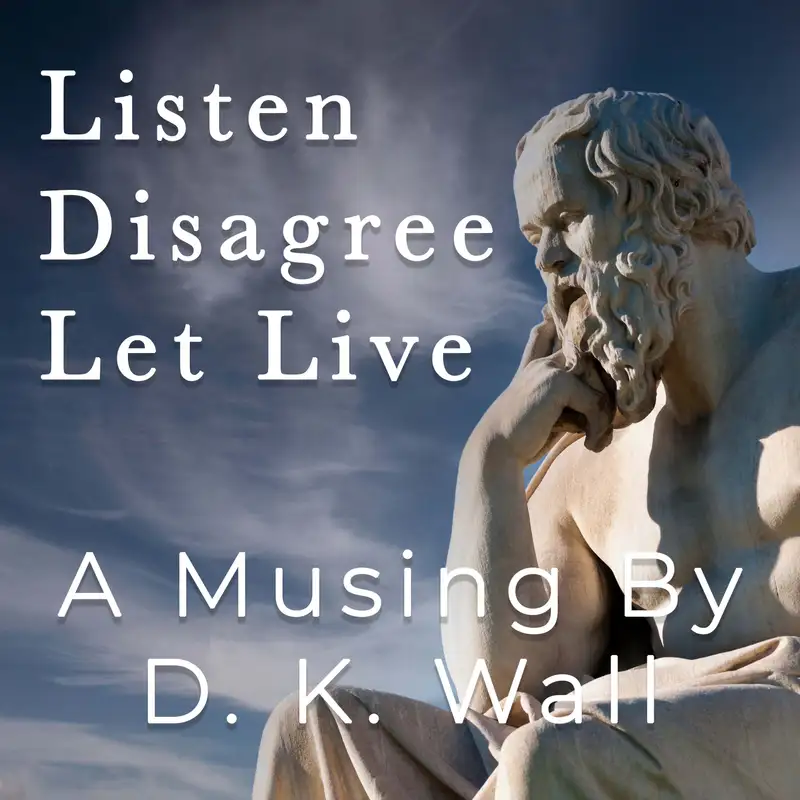
That's not what happened. The two men disagreed on many things. They quoted scripture, debated ramifications, and freely expressed their thoughts, but they never yelled or grew cross. Instead, they listened to each other and sought common ground wherever possible. And at the end, they shook hands and thanked each other for their time, a clear mutual respect coming from each of them. Those moments in that classroom represented an ideal of respectful dialogue, an ideal that feels dangerously fragile today. But it's not just a change in our times, because the impulse to silence speech with violence, sadly, is not new. In fact, it's ancient. A second death came to mind, though, in this case, it was ordered by the state nearly 2,500 years ago. In 399 BC, Socrates was brought before a jury of 500 of his fellow Athenians, accused of two crimes. The first, in piety, claimed he disrespected the city's religion. The second was the moral corruption of its youth. And how did this corruption happen? He debated ideas in a public forum. He was a gadfly walking the streets of Athens and asking uncomfortable questions and forcing people to examine their own beliefs. Historical accounts of the trial are few and sometimes contradictory, but we know the outcome. A jury of his peers, by a vote of 280 to 220, found him guilty. For the crime of asking questions, the sentence was death. In his jail cell, surrounded by his weeping disciples, Socrates calmly accepted a cup of poison hemlock, drank it, and waited for his heart to stop.
6:06
Again, I want to emphasize, I am not comparing Socrates' philosophy to Kirk's opinions or Rushdie's fiction. The point is not what their thoughts were. The mere concept that someone should die because of something they said or thought, should be horrific to all of us. Simply accepting disagreement should be a part of basic human decency. I do want to share one other thought, though. Socrates' ideas live on today not through his own writings. He wrote nothing down, but through those of his followers. Socrates himself argued that writing was a flawed medium because it weakened memory and didn't allow for the give and take of a real conversation. He believed the public debate was the true path to learning. I wonder what his reaction would be to today's public forum, the never-ending algorithmic brawl of social media. Or as I've taken to calling it, anti-social media. I find myself withdrawing from the online life more and more because I am as addicted as everyone else to the feeds, images, and the flashing colors like a Vegas casino. I now use the Freedom app to block my ability to access places like Facebook and its endless doom scrolling through most of the day. What was once fun for me has become a cesspool of conflict and secondhand rage. Now, I only go online with a specific purpose and a limited time window to get my tasks done. So let me end with advice from Utah Governor Spencer Cox, who said, and I quote, Social media is a cancer on our society right now. I would encourage people to log off, turn off, touch grass, hug a family member, go out, and do good in your community. Perhaps, if we all did that, if we all accepted a little more quiet in our lives, we can rediscover the decency required to listem, to disagree, and to let others live.