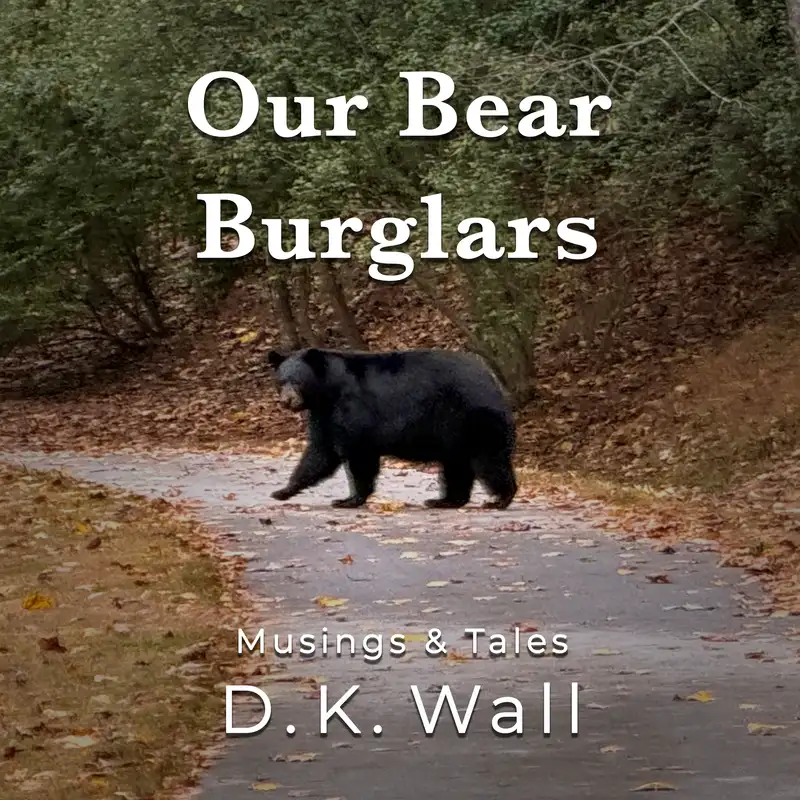
A hearty gang of burglars menaces our region with their thieving ways. Law enforcement blames them for dozens and dozens of home break ins. An official count of 71 so far this year for Buncombe County, where Asheville sits. They are crafty, persistent, and determined.
D. K. Wall:Stopping them has proven difficult, despite solid descriptions provided by victims. Between three hundred and four hundred pounds, long claws, sharp teeth, shiny black fur. I'm talking, of course, about our bears.
D. K. Wall:Now, let me get one thing out of the way right up front. Someone, probably many someones, will post a comment along the lines of "That's what you get from moving into the bears territory."
D. K. Wall:I get it. I don't even disagree. But here's a minor detail. If you live in North America, bears probably once roamed your land. That's true for most of the Northern Hemisphere, so Europe and Asia, you're included. Many of us live in what was or is bear country.
D. K. Wall:Our challenge here in Western North Carolina is population growth, both among humans and bears. By the 1970s, only a thousand or so black bears remained in all of North Carolina. Today, though, that number has rebounded to over 20,000, many of them living right here in the mountains surrounding us.
D. K. Wall:So, it is true that more and more people are moving to our area, building houses, apartments, and roads, a fact that many of you will no doubt point out. But the number of bears is growing too. Not just through conservation efforts preserving land at our national and state parks and forests, but also because the bears are adapting to city life amazingly well.
D. K. Wall:For years, I lived right on the border of the Great Smoky Mountains National Park at nearly a 5,000 foot elevation, about as rural as rural can get. The bears we encountered there were thinner and more scared of humans. In Asheville though, the bears are fatter and think little of walking through our yards.
D. K. Wall:Studies pardon the pun bear that out. Urban bears are heavier, live longer, and have more cubs each year. The difference? Access to human food.
D. K. Wall:Living rural, we hauled our trash to the dump. But here in Asheville, we roll our garbage cans to the street for the trash trucks to pick up. Bears consider this the weekly all you can eat buffet. It's easy to mark the path of their visit can after can lying on its side with its contents spilled into the street.
D. K. Wall:The city has introduced bear proof trash cans, but there are too few of them. People are on the wait list for months. Worse, they are given out first come, first served rather than saturating problematic neighborhoods.
D. K. Wall:Picture it. A bear approaches a trash can and tries to lift the lid, but the can resists its efforts. What does the bear do? Simple. Walk to the next trash can a few feet away. To truly discourage him, every can on the street needs to be resistant.
D. K. Wall:In fairness, even that might not work. Bears are smart. Very smart. They have learned that even bear proof cans can be opened when the proper amount of velocity is applied to throwing them. Engineering ursine style.
D. K. Wall:Even if we solved the trash problem, we'd still have to address all the other food sources bears find in a city. Those dumpsters behind restaurants. A grill on a back deck used to cook steaks or hamburgers, but not scrubbed clean. Bird feeders with their natural and wholesome selection of treats, which is why they are commonly called bear feeders around here. Pet food and treats left outside.
D. K. Wall:And like those trash cans, it only takes one neighbor, leaving a food source available, to send out an Earth sign dinner invitation to every bear in the neighborhood. Those food sources entice bears, which leads to increasing conflicts.
D. K. Wall:Unloading groceries from your car and carrying them into your house? Did you get them all, or did you leave a few bags for a second trip? Don't be surprised to discover Yogi inspecting your cargo.
D. K. Wall:You're extra vigilant, and you close your car doors between trips. But did you lock the doors? Bears can absolutely open car doors. I've watched them stroll through a parking lot, trying door after door like a teenaged hoodlum until they find one unlocked. I wouldn't be surprised the first time I see a bear hotwire a car and drive off.
D. K. Wall:So, you've locked your car doors every time you walk away from it. Are you locking your house doors and windows? Yes, bears can enter houses, and they do. Back to that official and couple of month old count of 71 homes broken into by bears in the county this year. That, of course, doesn't include the times people chase a bear out of their house and never report it to authorities.
D. K. Wall:Which brings us to another weird little fact. In the last decade, only eighteen people in the entire state of North Carolina have been injured in encounters with bears. Eleven of those happened right here in Buncombe County. To twist a great line from the Hunger Games, the odds are not in our favor.
D. K. Wall:A recent incident has brought all of this high into our minds. A woman surprised a bear in her own house. The bear swiped at her before escaping. Despite being sent to the hospital for her injuries, the woman asked that the bear not be euthanized.
D. K. Wall:The sad truth is that happens. There really aren't many options for a problematic bear. This bear, for example, has broken into more homes since that incident. Thus far, she has evaded capture and relocation. She has also, in true Asheville fashion, developed quite the fan club rooting for her.
D. K. Wall:Relocating bears sounds great, but it doesn't work well. Nearly every place suitable for bears is already claimed by other bears. A strange bear is a threat. Mortality rates for relocated adult bears are very high.
D. K. Wall:Young bears do better simply because they typically leave mom around 18 old. So a new young bear in a territory is considered to be just another yearling out on its own. Not exactly a welcome mat, but there's not the competitive animosity either.
D. K. Wall:The best thing we can do for bears is make sure they stay wild. That they don't become habituated to feeding from humans. Temporary regulations are in effect now, making it a finable offense to feed a bear intentionally or unintentionally. Hearings are being held to make that a permanent misdemeanor offense.
D. K. Wall:It's not as simple as it sounds. Is leaving dog food outside a crime? How about bird feeders? Where do we draw the line?
D. K. Wall:I don't have those answers, but please don't think those of us living here don't wanna share our world with these magnificent creatures. We're quite accustomed to living with them. Three times in the last week during our twice daily dog walks, I encountered bears less than a 100 yards away from us. Three. In a week. I'm certain other bears have been just as close, but invisible, hidden as we passed.
D. K. Wall:As frightening as that might sound to those of you who don't live in bear country, my experience is bears have little interest in us. If they hear us coming, they will slip into the shadows. If we come face to face, they prefer to slink away.
D. K. Wall:In all my years of hiking in these mountains, I've had hundreds, probably thousands, of encounters and only one was unpleasant. It was my fault.
D. K. Wall:We were walking the dogs, leashed, of course, along a trail. We didn't notice a pair of cubs playing off to the side. If we had, we would have given them a wide berth. Not because the cubs are scary, but because Mama is always somewhere close. And Mama is, well, a Mama. No one but no one threatens a mama's kids.
D. K. Wall:When we crossed some line she knew about but we didn't, she came charging through the brush toward us, growling her threats of harm. Trust me, we did not debate. In fact, I profusely apologized to her as we backed away. I assured her I meant no harm and it was all my fault. I knew perfectly well the importance of being aware of my surroundings and I had failed.
D. K. Wall:Funny aside, when I related our brush with nature to a friend shortly after it happened, he asked, "Were her ears up or laid back? Up means she was bluffing, trying to look as big as possible. Down means you were in real trouble."
D. K. Wall:I didn't know. I wasn't paying attention to her ears. I was a wee bit more focused on her teeth and claws and the fact that 300 pounds of angry mama bear was charging through the forest directly at us, telling us to get off her lawn. To this day, I can't remember which direction her ears pointed.
D. K. Wall:But even that moment, I chalk up as just a part of where we live.
D. K. Wall:So come visit us. Please enjoy the scenery. And if you are lucky enough to see bears, enjoy them from a safe distance. But do us all, including the bears, especially the bears, a big favor. Keep that food locked up.
D. K. Wall:Or don't be surprised if the next burglar you meet enjoys his right to bear arms. Sorry about that one. I couldn't bear to leave it out.