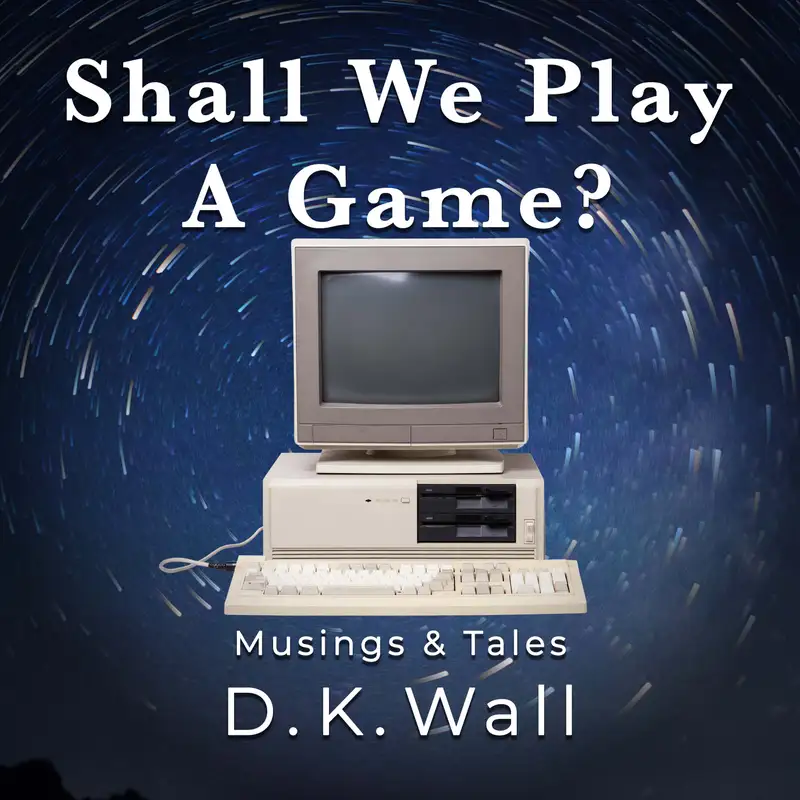
From time to time, something pops onto my radar that reminds me of the passing years. This week, it was WarGames. No, I don't mean some sort of military training exercise. I'm referring to the 1983 movie starring Matthew Broderick and a whole bunch of other people to make you feel old.
D. K. Wall:The opening scene features two members of the air force descending into a missile silo. Those two actors in bit parts were Michael Madsen, who would go on to be a favorite of Quentin Tarantino, and John Spencer, probably best known as Leo McGarry on The West Wing.
D. K. Wall:And that barely scratches the surface since the cast also includes Dabney Coleman, Ali Sheedy, Barry Corbin, and a young William H. Macy.
D. K. Wall:But today's Musing isn't about actors I've admired over the years nor is it about the various factual errors or continuity mistakes in the movie that people love to point out. It's Hollywood, so suspending disbelief goes with the territory.
D. K. Wall:What people forget though, or maybe are too young to realize, is that in 1983 when war games landed in theaters, it seemed cutting edge to most of us.
D. K. Wall:I was 19 that summer and had just finished my freshman year in college. I had never touched a computer until I arrived on campus. My high school certainly didn't have any.
D. K. Wall:Even a year into my collegiate career, my knowledge was limited to a semester of BASIC with all my homework stored on eight inch floppy disk that I had to lug to the computer lab a mile from my dorm.
D. K. Wall:To see Broderick's high school character, David Lightman, with a computer in his room at home was nearly unimaginable.
D. K. Wall:It would be years before I had my first portable computer at work, if you consider a 40 pound suitcase portable, and even more years before I had a computer at home.
D. K. Wall:The only computer technology I had in my room was Pong on a nine inch black and white TV. Believe it or not, that was one of my few claims to coolness.
D. K. Wall:So a couple of days ago when I saw the movie was available for streaming free on YouTube, I jumped at the chance.
D. K. Wall:I was prepared to find some of the technology dated, but I was astounded at how many things appear in it that would make no sense to anyone half my age, or frankly, even a good deal closer than that.
D. K. Wall:Take the first time we see David. He's in a video arcade playing Galaga. You know how many quarters I dropped into that game?
D. K. Wall:And, yes, quarters. Because the only way to play a video game was to walk to an arcade with a pocket full of change and feed the machine like it was a parking meter that let you shoot aliens.
D. K. Wall:Don't get me started on having to use a credit card on a parking meter nowadays. Such a simple thing has become so incredibly complicated.
D. K. Wall:In my case, that arcade was the local bowling alley where I spent many a Saturday morning blowing my paper route money on league bowling, video games, and greasy hot dogs.
D. K. Wall:How many people people growing up with a PlayStation or Xbox in their bedroom would understand that?
D. K. Wall:Things really got rocking in the movie when David needed to change his failing grade. He connected his computer to an acoustic coupler modem.
D. K. Wall:Yeah, I had never seen one of those. I was amazed that he physically cradled a telephone handset into two rubber cups and the computer and the phone talked to each other by making noises.
D. K. Wall:Remember, this was years before America Online and You've Got Mail. The screechy sound of a dial up connection wasn't common knowledge yet.
D. K. Wall:Alas, dial up came and went in my lifetime. So now we just complain about WiFi and don't truly understand the pain we once felt.
D. K. Wall:It gets better. To find a game to play, David programs his computer to dial every phone number in Sunnyvale, California one after another all night long hunting for other computers to answer.
D. K. Wall:The movie didn't invent the idea, but it sure gave it its name, war dialing.
D. K. Wall:The big fear expressed in the movie about the computer making so many calls was long distance charges. Remember those? Long distance could drain a paper route's worth of quarters in a single afternoon.
D. K. Wall:I was timing my calls home from college to coincide with the lowest rates. And of course, if you were waiting on a call, you had to sit by the phone.
D. K. Wall:Who worries about any of that now? Our phones, which we carry with us, can call across the country all for one low, low — oh, who am I kidding? — One outrageously exorbitant monthly flat fee.
D. K. Wall:Once David gets going with his hacking, he loads his programs off five and a quarter inch floppy disk.
D. K. Wall:Wait a minute. I had never seen one so small since I was still living in that eight inch world.
D. K. Wall:That cutting edge suitcase I received a few years out of college from work had slots for not one, but two five and a quarter inch floppies. One for the program and one for the data.
D. K. Wall:Most people today who remember floppies at all picture the hard plastic three and a halfs. The five and a quarters actually flopped. That's where the name came from.
D. K. Wall:But we're just getting started with the movie. How about the scene where Lightman uses a pay phone?
D. K. Wall:Yeah. Remember those? How many thousands of calls did I make from those things? Some of them on a rotary dial, no less, just like the phone I grew up with.
D. K. Wall:To get the payphone working without a coin, David shorts it out using a technological trick that makes no sense. But let's not worry about that.
D. K. Wall:The important part is that he searches the ground to find a discarded pull tab from the top of a soda can.
D. K. Wall:Remember those? You'd pop them clean off the can and then have a piece of metal dangling from your finger. What were you supposed to do with it? Toss it on the ground, cut your barefoot on one at the beach, or drop it in the can?
D. K. Wall:Gross. Right? I still remember my mother telling me how unsanitary that was. Who knew what had touched the top of that can?
D. K. Wall:Eventually, some genius decided it would be much better to leave the tab attached and just fold it down into your drink. You know, the dirty top of the can pressed right into the very liquid you're about to consume. Maybe those loose tabs were the right thing after all.
D. K. Wall:The movie keeps going. There's no Google in 1983. So when David needs to learn more about a reclusive scientist named Falken, he doesn't search on his computer. He goes to the library and digs through actual books and microfiche.
D. K. Wall:That was the part of the movie I most related to since the library was the only way I had to get my hands on knowledge. I loved libraries. When I wasn't in the aforementioned bowling alley consuming junk food and wasting money, the library was my home.
D. K. Wall:Later, David has to physically travel to find the man because the entire plot hinges on the fact that you couldn't just text someone. Hey. You up? Please stop the nuclear war.
D. K. Wall:When David arrives at NORAD, he comes face to face with the computer itself, WOPR, which speaks in a slow robotic monotone that absolutely blew our minds in 1983. It was so cool, a machine that talks.
D. K. Wall:Today, the device in my pocket talks to me constantly, reminds me of appointments, corrects my grammar, and judges everything I do. The future, it turns out, is a backseat driver.
D. K. Wall:But it wasn't just the voice. WOPR was supposedly one of the most powerful computers on earth. Yet, it took forever to come up with a 10 digit launch code or even to learn how to play tic tac toe.
D. K. Wall:Heck, my phone makes Whopper look like a Krystal burger or White Castle or whatever other bad fast food joke I could squeeze out of the word WOPR.
D. K. Wall:I could go on. The dot matrix printers and the fan fold paper with the little holes along the edges.
D. K. Wall:I've mentioned before that my first novel was written by hand in high school. No. You may not see it nor will anyone else. It's horrible.
D. K. Wall:The second one, though, I still have a draft printed on a dot matrix printer. No. You still can't see it. It's just a minor step above horrible.
D. K. Wall:But back to the movie. I wouldn't want them ever to do a remake. Sure. Upgrading the technology and weaving in the insanity of AI makes sense, at least in Hollywood. I shudder to think how much that stuff is already quietly running the modern day WOPRs.
D. K. Wall:No. I consider war games a time capsule that should be left alone. The technology screams how much has changed. The arcades, the floppies, the all night war dialing, the screech of a modem that nobody under 40 has ever heard.
D. K. Wall:And yet, I sat in front of a screen watching a movie I hadn't seen in decades, still rooting for the kid, still holding my breath at the end, still wondering how much we let computers run our lives.
D. K. Wall:Some games it seems we never stop playing, though perhaps Joshua had it right. The only winning move is not to play.